Events

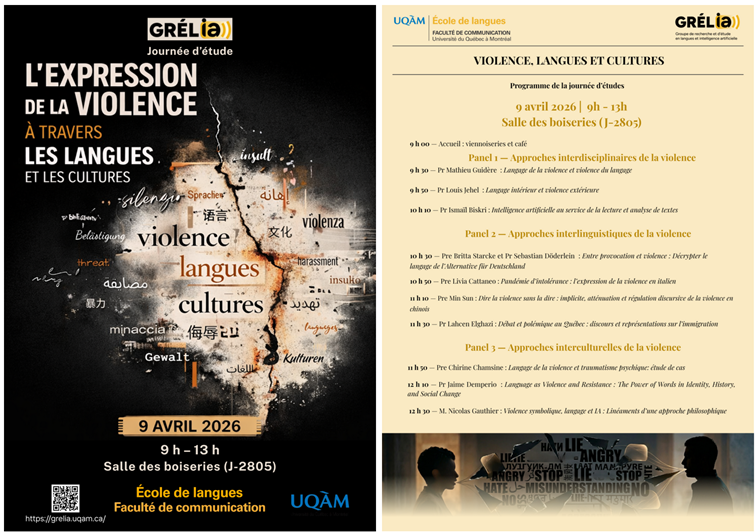
Symposium GRÉLIA, Spring 2026 :

The expression of violence across languages and cultures

The GRÉLIA symposium, scheduled for April 9, 2026, offers a scientific meeting devoted to the linguistic expression of violence across languages, examined in light of recent contributions from artificial intelligence. This event aims to explore how violence is articulated, structured and transmitted through language, depending on linguistic, cultural, social and institutional contexts.

Violence, whether physical, symbolic, institutional or verbal, cannot be reduced to observable acts alone. It is also embedded in discursive forms that contribute to its interpretation, normalization or contestation. The symposium draws on interdisciplinary research combining language sciences, social sciences, health sciences and artificial intelligence in order to analyze these linguistic forms from a comparative and applied perspective.

The presentations are organized around thematic axes defined by linguistic and cultural areas, making it possible to highlight both specific features and convergences in the expression of violence.

A first axis is devoted to Romance languages, with particular attention to processes of explicitation, moral qualification and legal narration of violence, especially in judicial, media and institutional discourses. The analyses examine how normative frameworks influence lexical and syntactic choices, as well as the designation of perpetrators and victims.

A second axis focuses on Semitic languages, with special interest in the cultural, historical and religious dimensions that permeate discourses of violence. The contributions analyze the use of metaphor, implicit meaning and allusion, as well as the tensions between social norms, legal prescriptions and individual expressions.

A third axis is dedicated to Germanic languages, exploring forms of distancing, categorization and rationalization of violence. The research presented examines how certain linguistic constructions contribute to objectifying facts, technicizing narratives or shifting responsibility, particularly in penal, administrative and media contexts.

A cross cutting axis concerns Asian languages, highlighting forms of verbalization in which violence may be euphemized, collectivized or integrated into traditional narrative frameworks. These analyses question the limits of automated models when confronted with linguistic and pragmatic systems that differ from the Western standards dominant in artificial intelligence technologies.

All of the axes draw on large scale multilingual corpora, including testimonies, judicial narratives, media discourses, digital exchanges and narrative productions. Language models derived from artificial intelligence are used to identify linguistic markers of violence, to connect micro and macro levels of analysis and to compare regularities and variations across languages and cultures, while also questioning the biases, blind spots and ethical issues associated with these tools.

The GRÉLIA symposium seeks to propose an international mapping of linguistic expressions of violence and to show how languages contribute to shaping the perception, understanding and discursive construction of violent phenomena. By bringing together language, power and social norms, this event aims to strengthen dialogue between disciplines and to open new perspectives for the comparative analysis of criminal, social and clinical discourses in a globalized context.

Research Question

How does Language, as both a cultural system and a social phenomenon, serve simultaneously as a vector for identity-based violence (discrimination, stigmatization) and a space of resistance where marginalized speakers verbalize and reclaim the violence they endure?

Axes of Research

To address this question, we focus on two main areas:

1. Hate Speech and Microaggressions: Through a corpus of contemporary discourse (social media, political debates), we examine the mechanisms by which language is used to formulate targeted acts of verbal violence aimed at excluding or “othering” marginalized identities.

2. Subversion and Linguistic Reclamation: We will highlight how minoritized communities use the same language as an instrument of verbal counter-violence and resilience. We study phenomena such as the reclaiming of slurs and the creation of counter-discourses that redefine identity in the face of systemic oppression.

Research Methodology

Our study relies on a multidisciplinary approach combining Critical Discourse Analysis (CDA, following the framework of Norman Fairclough), interactional sociolinguistics, and postcolonial studies.

Partners for this event

Participation of Chirine Chamsine:
Digital Learning Week 2025 :
AI and the future of education: Disruptions, dilemmas and directions
From 2 to 5 September 2025, UNESCO Headquarters, Paris, France.